


When a winch stops working, the motor gets blamed first. Sometimes that's right. But a lot of times the motor is fine and the problem is upstream — a bad solenoid, a wiring issue, a weak battery. Replacing a motor when you don't need to is an expensive mistake.
Before you order anything, test the motor. It takes about ten minutes.
Rule Out the Simple Stuff First
Before you pull the motor, check these — because if any of them are the issue, you'll find it faster.
Battery voltage under load Winch motors draw significant current. A battery that tests fine at rest may drop too low when the winch engages. If voltage drops below about 10 volts under load, the battery is your problem, not the motor.
Solenoid function The solenoid is the switching relay between your battery and motor. A bad solenoid can mimic a bad motor exactly. Listen for a click when you engage the winch control. A click means the solenoid is activating. No click means the solenoid isn't getting a signal, or the solenoid itself is bad.
If you hear a click but the motor doesn't run, the solenoid is activating but not passing current — which points to the motor or the wiring between the solenoid and motor.
We have detailed solenoid test procedures for both pre-2011 and 2011-to-present PIERCE solenoids on our Winch Maintenance & How To page — including terminal diagrams. If you haven't tested the solenoid yet, start there.
Wiring and connections Check the large-gauge cables between the battery, solenoid, and motor for corrosion, loose terminals, or damage. A corroded cable end can have enough resistance to prevent the motor from running.
How to Test a PIERCE Winch Motor
PIERCE electric winch motors have three posts: two field terminals (F1 and F2) and one armature post. The test procedure uses jumper wires to run the motor directly, bypassing the solenoid entirely.
What you need:
- A fully charged 12V battery
- Two heavy-gauge jumper wires with alligator clips
- A helper — one person to hold connections, one to observe
- The motor secured or strapped down — there is significant torque when power is applied
Standard and heavy duty motors both follow the same procedure. The post locations differ slightly by model — refer to the label on your motor or the Winch Maintenance & How To page for a photo reference.
Testing Direction 1
- Ground the motor casing. If you can't get a good clamp on the casing, thread a bolt into it and clamp to that.
- Run a jumper wire from F2 to the armature post.
- Apply 12V power to F1.
- The motor should run. Note the direction.
Testing Direction 2
- Keep the casing grounded.
- Move the jumper wire — now run it from F1 to the armature post.
- Apply 12V power to F2.
- The motor should run in the opposite direction.
What the Results Mean
Motor runs in both directions — the motor is good. Your problem is upstream: solenoid, wiring, or battery under load.
Motor runs in one direction only — one field winding may be damaged. The motor may still function but should be inspected further or replaced depending on your application.
Motor hums but doesn't turn — the motor is trying but can't. Either the armature is seized or the gear train is jammed. Try both directions. If it hums both ways without turning, the motor or drum is mechanically stuck.
Motor runs sluggishly or makes bad sounds — worn or damaged internals. May still function temporarily but replacement is the better long-term call.
Direct short — sparks immediately, doesn't spin — the motor is failed. Replace it.
Motor does nothing — check your connections first. If connections are solid and there's still no response, the motor has an open winding and needs replacement.
If You Need to Replace the Motor
Call us at 940.538.5643 with your winch model number — it's on a label on the drum housing. A few important notes when installing a replacement motor:
- Seat the O-ring on the motor shaft all the way down before installing the gear
- Position the gear all the way down the shaft, not flush to the end — running it at the end will interfere with the gear case and cause metal shavings inside the housing
- Apply a small amount of Loctite to the set screw on the gear — if that screw backs out inside the gear case, you'll be replacing all the gears
One More Thing
If your motor passes the test but runs slowly under load, the brushes may be worn. Brushed DC motors degrade gradually — they'll still run but lose torque over time. Also check for mechanical drag in the drum or fairlead, and confirm your battery is holding voltage under the full winch load before assuming the motor is the issue.
For a full maintenance checklist — lubrication points, cable inspection, grounding procedure, and greasing the clutch housing — see our Winch Maintenance & How To page.
Watch: How to Test a PIERCE Winch Motor
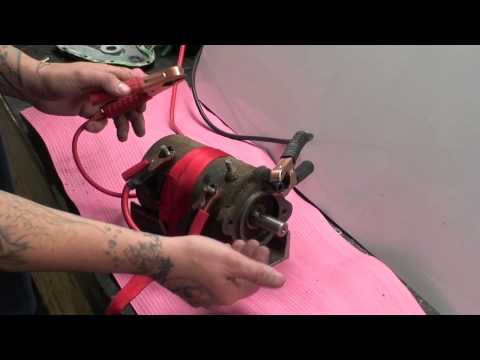
This is a test on a PS534H and PS534HD motors to PS654 PIERCE winches. This video will also show signs of a faulty motor.